What is a credit card point worth?
 Aaron Sulbaran · · 13 min read
min/Max is meant to solve a problem that sounds simple, personalizing how each person uses their cards and earns rewards, until the tool has to put a number next to the word "points," which forces the question of what a credit card point is actually worth. There is no single clean answer, as you'll see. It's a question with real money behind it, since US-issued Visa, Mastercard, American Express, and Discover credit cards carried $6.136 trillion in purchases in 2024 [1].
Less than you expect, but more than you're shown
In one sentence, that's the answer, and its two ends come from different places. The low end, about 0.6 cents on an American Express (AmEx) Membership Rewards point, comes from AmEx itself, which publishes it as the rate for its own cash-out option [2]. The high end, roughly 2 cents, comes from valuation sites such as The Points Guy (2.0) and Upgraded Points (2.2) [3][4]. Where any one person lands between them depends on what they know and what they're shown, and as far as I can find, nobody has measured that middle.
One AmEx point has seven different prices
I got my first credit card the week I turned 18. If you don't know me, that sounds reckless, but I had already spent hours on YouTube videos, blogs, and the banks' own pages, and I walked in believing a point was worth one cent, always. Most people never get those hours, and they shouldn't need them, so what happens to the people who jump into a card at 18 without that research and make bad decisions? Past that one-cent assumption I found that AmEx points are often valued above Chase points, sometimes the reverse, and that transfer partners, mergers, and legal details keep moving the answer, so it never stops changing.
Here are seven published prices for one AmEx point as of September 2026.
| Source | Cents per point | What it measures |
|---|---|---|
| AmEx issuer cash | 0.6 | What AmEx itself pays when you cash points out against your bill [2] |
| NerdWallet baseline | 1.0 | Its baseline for AmEx points (it lists a value of 1.3 beside it) [5] |
| Frequent Miler | 1.5 | The midpoint, where half of available awards are worth more and half less [6] |
| One Mile at a Time | 1.7 | One flat, deliberately conservative number for the big bank currencies [7] |
| The Points Guy | 2.0 | What a traveler can reasonably expect from their best regular redemption type [3] |
| AwardWallet | 2.03 | An average from about 71,000 real bookings by its members, which skews toward enthusiasts [8] |
| Upgraded Points | 2.2 | Its published monthly valuation for AmEx points [4] |
None of these sources is wrong. They answer slightly different questions, and none knows how you redeem.
There's a floor, a published high end, and a middle too personal to measure
Banks already assign a point a number, and unsurprisingly it's the one that suits them. For AmEx that is 0.6 cents through Cover Your Charges as of April 2026, the issuer-published and easiest option rather than the average, and it's what comes up when you search for what AmEx points are worth in cash. Better options exist, but they take a hunt to find.
A quick search will also show you the published high end, what you get if you do the right things in the right order. TPG describes its own number as neither a bare minimum nor the maximum from an exceptional redemption [9], and the true top end, the premium cabin sweet spots, runs higher and is rare.
Most consumers redeem somewhere in between, and that middle can't really be measured. AwardWallet is the nearest thing, but it isn't accurate for everyone or personalized, since it comes from people who care enough to track their miles in an app. The customers who aren't tracking miles or maximizing every redemption end up with the shorter end, often at or near that 0.6 cents, and nowhere near the 2.0 to 2.2 at the top.
Why not just ask the banks?
They won't say, even though their accounting requires an answer. AmEx's annual report shows a Membership Rewards liability of $16.52 billion and an Ultimate Redemption Rate of 96 percent (rounded down) at December 31, 2025, built from that rate and a weighted average cost per point [10]. The 96 percent is the share of points expected to be redeemed, not a value per point, and the cost per point is never stated. JPMorgan Chase, for its part, names a cost per point assumption without giving it [11].
The advertised values have their own problem
The problem is who publishes them. Accountable.us reported in 2024 that TPG's card offers are affiliate links and that its affiliate revenue topped $50 million in 2019 [12], and Marc Rubinstein noted that Avios Group booked deferred revenue at about 0.62 pence per point issued in 2022, roughly 52 percent of the 1.2 pence TPG assigned Avios [13]. None of this is an attack on those sites, which do useful work, just something a conscious consumer should be conscious of.
Cashing out is easy, but finding good redemptions is not
In a bank's app, cashing out is always prominent, usually a button offering to redeem all or part of your points against recent purchases, and it typically pays close to that bottom number. Beyond it sits a hierarchy of options, not the only ones but the main ones, in order of value to you: cashing out at the bank's base value, then booking through the bank's own portal (Chase Travel, AmEx Travel, Capital One Travel), then transferring to an airline or hotel partner, best during a transfer bonus. I read that prominence as the bank pointing you at what suits it, though that's my read of the pattern and not something I can see inside a bank.
The ladder isn't the bank paying more as you climb it, though. A portal booking is a real booking paid at the supplier's rate and offset by a commission (Chase Travel reportedly did $11.3 billion in 2024 sales [14], with commissions Leff put at up to $750 million [15]). A transfer means the bank has already bought the partner's currency, typically in bulk under contract [16], at prices reported around 1 to 1.5 cents per mile [17][18], so the user's extra value comes from the partner accepting fewer points for a seat than the bank paid, and the airline decides how many you need. On Chase that means partners such as United MileagePlus, Southwest Rapid Rewards, World of Hyatt, and Marriott Bonvoy [19].
Transfer bonuses show the same pattern from the other side. Computed from Frequent Miler's bonus history, over 24 months at least one Chase transfer bonus to some partner was live on 94 percent of days (AmEx 74, Citi 73, Capital One 58) [20]. There is rarely one for the airline you actually fly, and a lot of opportunities isn't the same as awareness, since a bonus means little if nothing tells you when one shows up, or if the partner someone is excited about next month is one you won't glance at. So a bonus can't be a normal rate. It's a variable inside a range, and that variable can be computed with the right tools, especially frontier tools like AI, which is the computation we want min/Max to do.
Ecosystems are how banks keep winning. Citi's own calculator prices 5,000 ThankYou points at $25 on a Strata card and $50 on a Double Cash [21], and the Chase trifecta pools points across three cards [22]. It resembles Apple's walled garden applied to finance, where a point is worth more if you own the next card.
None of this means banks lose money on rewards in any way that matters, because a loss on one customer is negligible across millions of cardholders. A New York Fed staff report finds that interchange income averages 1.82 percent of purchase volume while rewards cost 1.57 percent and card lending earns a 6.8 percent return on assets [23], though those are portfolio averages and say nothing about any one heavy optimizer. Even a maximalist doesn't really make the bank lose. A bank has millions of cardholders and has thought about this far longer than any one of us has, so trying to make it lose isn't realistic, and the sensible aim is to do what's best for you.
A rewards program built for the user is hard to keep running
Just because banks don't lose doesn't mean nobody has tried to build a rewards program mainly for the user, and I lived one firsthand. As a college student paying my own rent, I sorted my needs from my wants, and rent was my biggest need by a wide margin, as it is for most people, so it was where I wanted my money to work hardest. My rule was "minimize spend, maximize rewards," which became my motto and led to the min/Max name you know now.
Bilt is a company that lets you earn points on rent with no transaction fee, and the Bilt Mastercard, launched in June 2021 [24] and issued by Wells Fargo from March 2022 [25], was my third card.
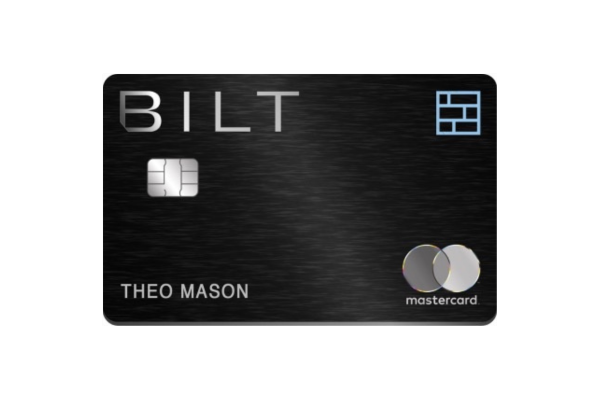
There was a rule to deal with. At launch, rent points depended on how much else you spent, with no five-transaction count [26], but by September 2021 the card required five transactions per statement period [27][28], and Wells Fargo's March 2022 release carried it forward [25]. I opened my card later, so the rule was already standard, and I didn't notice it until I missed my first rent points. When you fall short, a rent payment earns a flat 250 points instead of 1x on rent [29]. On my rent of more than $1,200 that's about $2.50 instead of about $12 at 1 cent per point, every month. A rule you don't notice costs real money, and fine print like this is exactly what people gloss over and an agent reading every term never would, which is something to explore in a future post.
I read the rule as the beginning of the end, a sign the program couldn't pay out everything it promised, and I don't blame them for cuts they probably didn't want to make. The Wall Street Journal reported in June 2024 that Wells Fargo was losing as much as about $10 million a month on the card, per secondary coverage [30], and its early exit was reported in July 2025 [31]. Bilt relaunched in February 2026 as three cards issued by Column N.A. [32]. The first version of the new rent terms drew backlash and was reversed within days [33][34], though the reworked program ties its best rent earning to spending on the card [33]. That rewards big spenders, which didn't fit me, and I didn't cancel. Existing cardholders could move to a new card or be converted to a Wells Fargo Autograph card [35], and I took the Autograph route, because closing it would have shortened my average age of credit (it was one of my oldest accounts) and hurt my score. Bilt's terms say an account goes inactive after 18 months without qualifying activity [36].
- The Bilt Mastercard launches, earning points on rent [24]
- Rent points now need five transactions per statement period [27][28]
- Wells Fargo issues the card and carries the rule forward [25]
- Wells Fargo reported losing as much as about $10 million a month on the card [30]
- Rent Day: a one-day transfer bonus to Southwest [37][38]
- Wells Fargo's early exit is reported [31]
- Bilt relaunches as three cards issued by Column N.A. [32]
1x on rent against a flat 250 points, at 1 cent per point [29]
The payoff came before all of that, on May 1, 2025, when Bilt ran a one-day Rent Day transfer bonus to Southwest, the only one in public coverage [37][38]. I transferred 26,000 Bilt points, and Southwest posted 26,000 plus a separate 6,500-point bonus (25 percent), 32,500 in total. The same day I booked a round trip to California for two, to San Diego and Los Angeles, for 25,485 points. At NerdWallet's 1.4 cents and TPG's 1.25 cents per point that is about $320 to $355 of travel [39][3], and because of the bonus the flight effectively cost about 20,400 Bilt points.
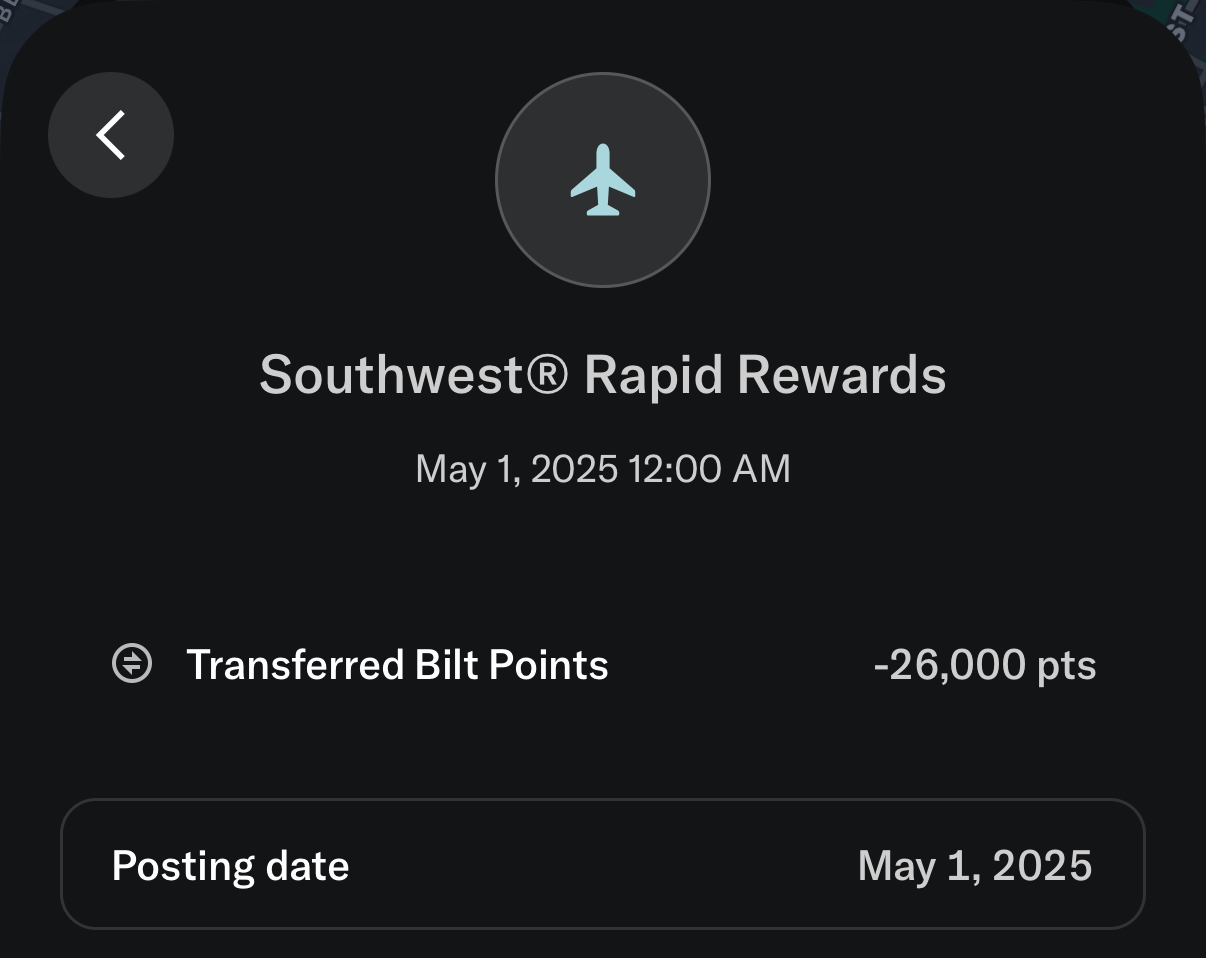
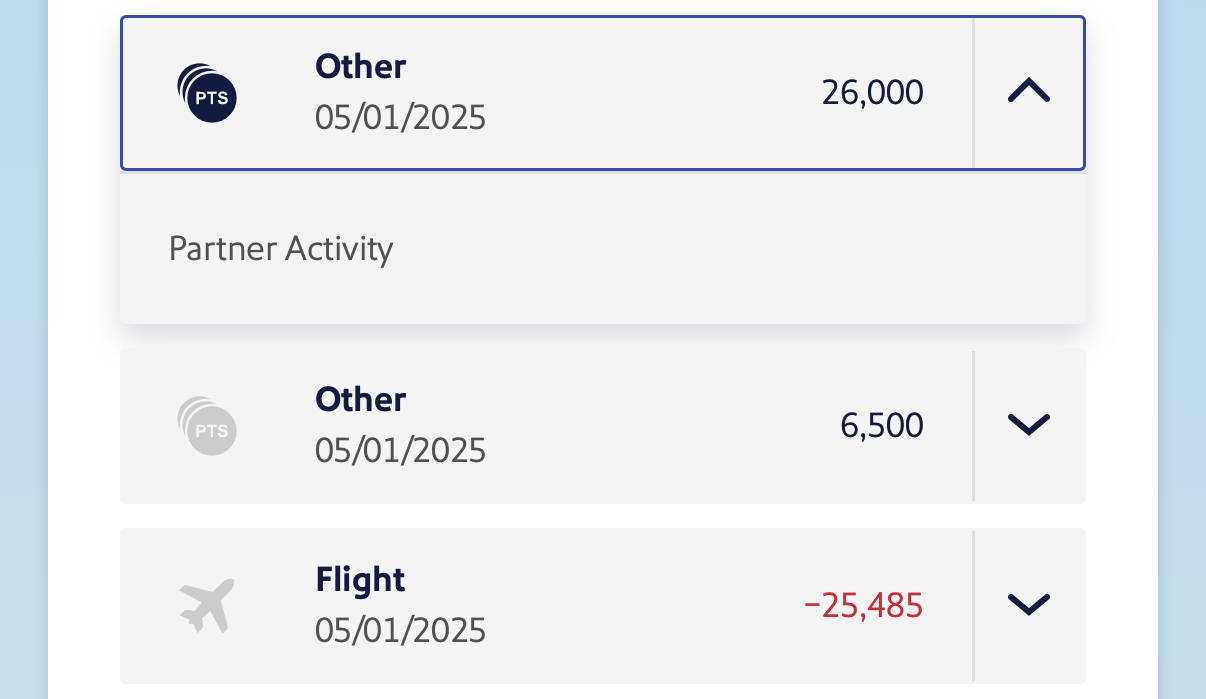
- Transferred
- 26,000
- Bonus (25%)
- +6,500
- Southwest points
- 32,500
- Round trip for two
- 25,485
About $320 to $355 of travel at 1.25 to 1.4 cents per point [39][3]
I don't see any of this as Bilt failing. Their original idea rewarded renters, and market economics and their issuer pushed the business in a different direction, and I think they're still wildly successful. I'm still in the ecosystem, since my apartment, a student housing property, is a Bilt partner, so I pay rent through Bilt without the card, and I respect the business model and its landlord partnerships (Bilt calls its network of property owners and operators the Bilt Alliance [40]). My take, and it's an opinion supported by that history, is that a rewards program built mainly for the user is hard to sustain, even with one of the biggest banks behind it, and the issuer can change the rules underneath you. min/Max is meant to be a tool, not a provider or a bank, which brings up the question of who gets what from the same points.
One assumption fails everyone in a different way
Take three people holding the same points. The budget traveler wants as many trips as possible, so every point has to stretch, a wealthy user might drain the balance on one first-class seat and pay for the rest of the trip out of pocket, and a third person wants cash back to pay down a card balance. Each can redeem well by their own measure and land on a different figure.
A Federal Reserve working paper estimates that reward cards move $15.1 billion a year from cardholders with lower credit scores to those with higher ones, and finds the pattern follows financial sophistication and not only income [41], which matches my sense that the people who capture high point values are mostly the ones who learned the system, like me at 18 after hours of research. I was the engaged user, and a tool showing me only the cash-out value would have pointed me at a ridiculous way to redeem. So the answer isn't the floor and it isn't the high end. It's a range, contingent on the user, their goals, and what they want.
Each of the three sits in a different part of it. The budget traveler usually lands in the middle to upper middle, with domestic redemptions like Southwest at about 1.25 to 1.4 cents [39][3]. The wealthy traveler can reach the very top, with something like Japan Airlines first class, a coveted award released about a year out whose best seats can vanish within hours [42][43]. The cash-back user isn't on the points scale at all, since the question for them is which cards return the most cash as easily as possible, such as 2 percent on everything or a rotating 5 percent card, combined to pay a balance down faster. So what is a point worth? For the first it's a stretch across many trips, for the second a single seat at the top of the range, and for the third it isn't measured in points at all.
There's a hopeful side to this. A user can move faster than a bank can change its rules or ship a change, so an informed user can outsmart the bank. The catch is that it takes information and time most people don't have.
What we don't know yet
There are things we don't know yet, and each is a reason to build around personalization. We don't know the true average, meaning what the typical cardholder actually gets from a point. We don't know the cards and use cases outside any one wallet, though I know far more cards than I hold (I carry six and have never paid interest). And we don't know enough about users deep in debt, a group that isn't small, with Experian's average card balance for Gen Z at $3,493 as of June 2025 [44] and total US credit card balances at $1.26 trillion in the second quarter of 2026 [45]. For someone carrying a balance, cash back that pays it down may matter more than any travel redemption. Learning from users and interviewing them is how a personalization layer fills those gaps, and how we build for everyone.
Why now
What makes this possible now is applied AI and the context layer it allows, a copilot that grows with you over time, learns what you want, and helps you land on the best card at checkout with proof of why. A rules engine needs you to translate your goal into numbers in a settings screen, and that translation goes stale the moment a bonus or your plans change. With AI you can say the goal in plain words, for example Tokyo next spring and economy is fine, and the context layer keeps that translation current. AI understands and remembers what you want, but the math stays checkable. That's my bet on why this needs to be built now.
The point isn't to make banks lose. It's to focus on what's best for you, and for builders in other fields the least to take away is that you can build a personalization layer for something you care about, wherever a system hands you one default and the useful answer depends on who you are. A point is what the user makes of it.
Sources
- Nilson Report. 2025. "JP Morgan Tops Nilson Report Ranking of US Credit Card Issuers." GlobeNewswire. March 6, 2025. https://www.globenewswire.com/news-release/2025/03/06/3038338/0/en/jp-morgan-tops-nilson-report-ranking-of-us-credit-card-issuers.html. Figure originates in Nilson Report, no. 1280 (February 2025). Accessed September 29, 2026. ↩
- American Express. 2026. "How Much Are American Express Membership Rewards Points Worth?" American Express Credit Intel. Last modified April 30, 2026. https://www.americanexpress.com/en-us/credit-cards/credit-intel/american-express-points-value/. Accessed September 29, 2026. ↩
- The Points Guy. 2026. "What Are Points and Miles Worth? TPG's Sept. 2026 Valuations." The Points Guy. September 1, 2026 (modified September 9, 2026). https://thepointsguy.com/guide/monthly-valuations/. Accessed September 29, 2026. ↩
Show all 45 sourcesShow fewer sources
- Upgraded Points. 2026. "Points and Miles Valuations." Upgraded Points. Updated September 17, 2026. https://upgradedpoints.com/travel/points-and-miles-valuations/. Accessed September 29, 2026. ↩
- NerdWallet. 2026. "Airline Miles and Hotel Points Valuations." NerdWallet. Updated September 14, 2026. https://www.nerdwallet.com/article/travel/airline-miles-and-hotel-points-valuations. Accessed September 29, 2026. ↩
- Frequent Miler. 2026. "Reasonable Redemption Values (RRVs)." Frequent Miler. September 1, 2026 (modified September 2, 2026). https://frequentmiler.com/reasonable-redemption-values-rrvs/. Accessed September 29, 2026. ↩
- Schlappig, Ben. 2026. "How Much Are Airline, Hotel, And Credit Card Points Worth?" One Mile at a Time. September 2, 2026. https://onemileatatime.com/guides/value-miles-points/. Accessed September 29, 2026. ↩
- AwardWallet. 2026. "Point and Mile Values." AwardWallet Loyalty data, read live September 28, 2026 (about 70,960 bookings behind the AmEx average). https://loyalty.awardwallet.com/v1/point-mile-values/list. Methodology: https://awardwallet.com/features/awardwallet-mile-valuations/. Accessed September 29, 2026. ↩
- The Points Guy. 2026. "How TPG Calculates Points and Miles Valuations." The Points Guy. August 3, 2026 (page metadata date; author byline unconfirmed). https://thepointsguy.com/loyalty-programs/points-miles-valuations-methodology/. Accessed September 29, 2026. ↩
- American Express Company. 2026. Form 10-K for the Fiscal Year Ended December 31, 2025. U.S. Securities and Exchange Commission. February 6, 2026. https://www.sec.gov/Archives/edgar/data/4962/000000496226000080/axp-20251231.htm. Accessed September 29, 2026. ↩
- JPMorgan Chase & Co. 2026. Form 10-K for the Fiscal Year Ended December 31, 2025. U.S. Securities and Exchange Commission. February 13, 2026. https://www.sec.gov/Archives/edgar/data/19617/000162828026008131/jpm-20251231.htm. Accessed September 29, 2026. ↩
- Accountable.US. 2024. "REPORT: 'The Points Guy' Maintains Close, Often Misleading Relationship with Shady Financial Industry." Accountable.US. February 29, 2024. https://accountable.us/report-the-points-guy-maintains-close-often-misleading-relationship-with-shady-financial-industry/. Accessed September 29, 2026. ↩
- Rubinstein, Marc. 2024. "The Points Guy." Net Interest. January 12, 2024. https://www.netinterest.co/p/the-points-guy. Accessed September 29, 2026. ↩
- Schaal, Dennis. 2025. "The B2B Battleground: Expedia, Booking and Hopper Are Redefining Online Travel's Quiet Money Machine." Skift, via Yahoo Finance. September 15, 2025. https://finance.yahoo.com/news/b2b-battleground-expedia-booking-hopper-152513576.html. Accessed September 29, 2026. ↩
- Leff, Gary. 2023. "Chase About To Pass American Express, Become Third Largest Travel Agency Behind Expedia, Booking.com." View from the Wing. December 16, 2023. https://viewfromthewing.com/chase-about-to-pass-american-express-become-third-largest-travel-agency-behind-expedia-booking-com/. Accessed September 29, 2026. ↩
- Consumer Financial Protection Bureau. 2024. "Credit Card Rewards Issue Spotlight." May 2024. https://files.consumerfinance.gov/f/documents/cfpb_credit-card-rewards_issue-spotlight_2024-05.pdf. Accessed September 29, 2026. ↩
- Leff, Gary. 2023. "The Secret Economics Of Airline Miles: What Banks Really Pay Vs. What You Think." View from the Wing. December 2, 2023. https://viewfromthewing.com/the-secret-economics-of-airline-miles-what-banks-really-pay-vs-what-you-think/. Accessed September 29, 2026. ↩
- Schlappig, Ben. 2025. "How Much Do Credit Card Issuers Pay For Airline & Hotel Points?" One Mile at a Time. November 9, 2025. https://onemileatatime.com/insights/credit-card-pay-airline-hotel-points/. Accessed September 29, 2026. ↩
- Chase. 2026. "Chase Sapphire Preferred Card." JPMorgan Chase. https://creditcards.chase.com/rewards-credit-cards/sapphire/preferred. Accessed September 29, 2026. ↩
- Frequent Miler. n.d. "Current Point Transfer Bonuses." Frequent Miler. https://frequentmiler.com/current-point-transfer-bonuses/. Share-of-days figures are calculated from the page's active and expired bonus tables for the 24 months ending September 28, 2026; Frequent Miler does not publish them. Accessed September 29, 2026. ↩
- Citigroup. n.d. "ThankYou Points Transparency" (interactive redemption calculator, read September 28, 2026). ThankYou.com. https://www.thankyou.com/pointsTransparency.htm. Accessed September 29, 2026. ↩
- Johnson, Holly D., and Seychelle Thomas. 2025. "The Chase Trifecta: What It Is and How to Maximize It." Bankrate. August 25, 2025. https://www.bankrate.com/credit-cards/reviews/chase-trifecta/. Accessed September 29, 2026. ↩
- Drechsler, Itamar, Hyeyoon Jung, Weiyu Peng, Dominik Supera, and Guanyu Zhou. 2026. "Credit Card Banking." Federal Reserve Bank of New York Staff Reports, no. 1143. March 2025, revised August 2026. https://www.newyorkfed.org/research/staff_reports/sr1143. Accessed September 29, 2026. ↩
- Mastercard. 2021. "Bilt Rewards and Mastercard Team Up to Launch the Bilt Mastercard." Mastercard Newsroom. June 22, 2021. https://newsroom.mastercard.com/news/press/2021/june/bilt-rewards-and-mastercard-team-up-to-launch-the-bilt-mastercard/. Accessed September 29, 2026. ↩
- Wells Fargo. 2022. "Wells Fargo Partners with Bilt Rewards and Mastercard to Issue the First Credit Card That Earns Points on Rent Payments without the Transaction Fee." Wells Fargo Newsroom. March 28, 2022. https://newsroom.wf.com/news-releases/news-details/2022/Wells-Fargo-Partners-with-Bilt-Rewards-and-Mastercard-to-Issue-the-First-Credit-Card-that-Earns-Points-on-Rent-payments-without-the-Transaction-Fee/default.aspx. Accessed September 29, 2026. ↩
- Chuck. 2021. "Bilt Rewards Rent Payment & Credit Card Review, Earn Points on Rent Payments with No Fees." Doctor of Credit. June 23, 2021. https://www.doctorofcredit.com/bilt-rewards-rent-payment-credit-card-review-earn-points-on-rent-payments-with-no-fees/. Accessed September 29, 2026. ↩
- Dong, Chris. 2021. "3 Months After Launch, the Company That Lets You Earn Points on Rent Is Reinventing Itself." The Points Guy. September 21, 2021. https://thepointsguy.com/news/bilt-rewards-credit-card-rent/. Accessed September 29, 2026. ↩
- Charles, William. 2021. "Bilt Rewards (Rent Payment & Credit Card) Makes Significant Changes." Doctor of Credit. September 22, 2021. https://www.doctorofcredit.com/bilt-rewards-rent-payment-credit-card-makes-significant-changes/. Accessed September 29, 2026. ↩
- Bilt Rewards Support. n.d. "What Is the 5 Minimum Transaction Requirement?" Bilt Rewards Support. https://support.biltrewards.com/hc/en-us/articles/10508337751309-What-is-the-5-minimum-transaction-requirement. Read through a search-result excerpt only (the page returned an access error). Accessed September 29, 2026. ↩
- Schlappig, Ben. 2024. "Bilt Economics Revealed: Wells Fargo Losing Money?" One Mile at a Time. June 16, 2024. https://onemileatatime.com/news/bilt-economics-wells-fargo-losing-money/. Relays reporting by the Wall Street Journal (June 2024), which is paywalled. Accessed September 29, 2026. ↩
- Bachman, Justin. 2025. "Bilt's New Cards Expand Options." Payments Dive. July 29, 2025. https://www.paymentsdive.com/news/bilts-new-cards-seek-to-fix-past-faults-rewards-credit-cards-travel-hotels-airlines/756103/. Accessed September 29, 2026. ↩
- Doctor of Credit. 2026. "Bilt 2.0 Cards: Blue, Obsidian, Palladium." Doctor of Credit. January 14, 2026. https://www.doctorofcredit.com/three-brand-new-bilt-2-0-cards-blue-obsidian-palladium/. Accessed September 29, 2026. ↩
- Bilt Rewards. 2026. "A Note from Ankur Jain: Bilt Card 2.0: Simple, Fee-Free Rewards on Housing." Bilt Newsroom. January 16, 2026. https://newsroom.biltrewards.com/biltcardupdate. Accessed September 29, 2026. ↩
- Klint, Matthew. 2026. "Bilt Guarantees Points on Rent and Mortgage Payments After Member Backlash." Live and Let's Fly. January 17, 2026. https://liveandletsfly.com/bilt-guarantees-points-on-rent/. Accessed September 29, 2026. ↩
- Schlappig, Ben. 2025. "Details: Bilt Launching Three Cardless Credit Cards, Ditching Wells Fargo." One Mile at a Time. December 27, 2025. https://onemileatatime.com/news/bilt-cardless-credit-cards/. Accessed September 29, 2026. ↩
- Bilt Rewards. 2026. "Bilt Rewards Terms and Conditions." Bilt Rewards. Last updated July 14, 2026. https://www.biltrewards.com/terms. Accessed September 29, 2026. ↩
- Steinke, Tim. 2025. "Bilt Rewards: Up to 100% Transfer Bonus to Southwest Rapid Rewards." Frequent Miler. May 1, 2025. https://frequentmiler.com/bilt-rewards-up-to-100-transfer-bonus-to-southwest-rapid-rewards/. Accessed September 29, 2026. ↩
- Doctor of Credit. 2025. "[Expired] Bilt Rent Day (May 2025): Up To 100% Southwest Transfer Bonus." Doctor of Credit. May 1, 2025. https://www.doctorofcredit.com/bilt-rent-day-may-2025-up-to-100-southwest-transfer-bonus/. Accessed September 29, 2026. ↩
- NerdWallet. 2026. "What Is the Value of Southwest Rapid Rewards Points?" NerdWallet. Updated August 31, 2026. https://www.nerdwallet.com/travel/learn/how-much-are-my-southwest-rapid-rewards-points-worth. Accessed September 29, 2026. ↩
- Bilt Rewards. n.d. "Bilt Alliance." Bilt Rewards. https://www.biltrewards.com/alliance. Accessed September 29, 2026. ↩
- Agarwal, Sumit, Andrea Presbitero, André F. Silva, and Carlo Wix. 2023. "Who Pays For Your Rewards? Redistribution in the Credit Card Market." Finance and Economics Discussion Series 2023-007. Board of Governors of the Federal Reserve System. January 2023. https://doi.org/10.17016/FEDS.2023.007. Accessed September 29, 2026. ↩
- Schlappig, Ben. 2024. "How To Redeem Miles For Japan Airlines A350 First & Business Class." One Mile at a Time. December 11, 2024. https://onemileatatime.com/insights/redeem-miles-japan-airlines-a350-first-business-class/. Accessed September 29, 2026. ↩
- Prince of Travel. 2026. "The Complete Guide to Japan Airlines First Class." Prince of Travel. Updated February 12, 2026. https://princeoftravel.com/airlines/japan-airlines-first-class/. Accessed September 29, 2026. ↩
- Experian. 2025. "Average Credit Card Debt by Age in 2025." Experian. September 17, 2025. https://www.experian.com/blogs/ask-experian/research/credit-card-debt-by-age/. Accessed September 29, 2026. ↩
- Federal Reserve Bank of New York. 2026. "Household Debt Balances Decreased Slightly; Credit Card Delinquency Transition Rates Remained Steady." Press release. August 11, 2026. https://www.newyorkfed.org/newsevents/news/research/2026/20260811. Accessed September 29, 2026. ↩
 Aaron Sulbaran